
DeepTutor vs Traditional Literature Review
By DeepTutor Team, Research & Product • Nov 24, 2025 • Updated Nov 24, 2025 • 6 min read
A traditional literature review is the summary and evaluation of scholarly work on a specific topic. They are an essential process because they give a coherent overview and identify gaps in existing research that a new study could investigate.
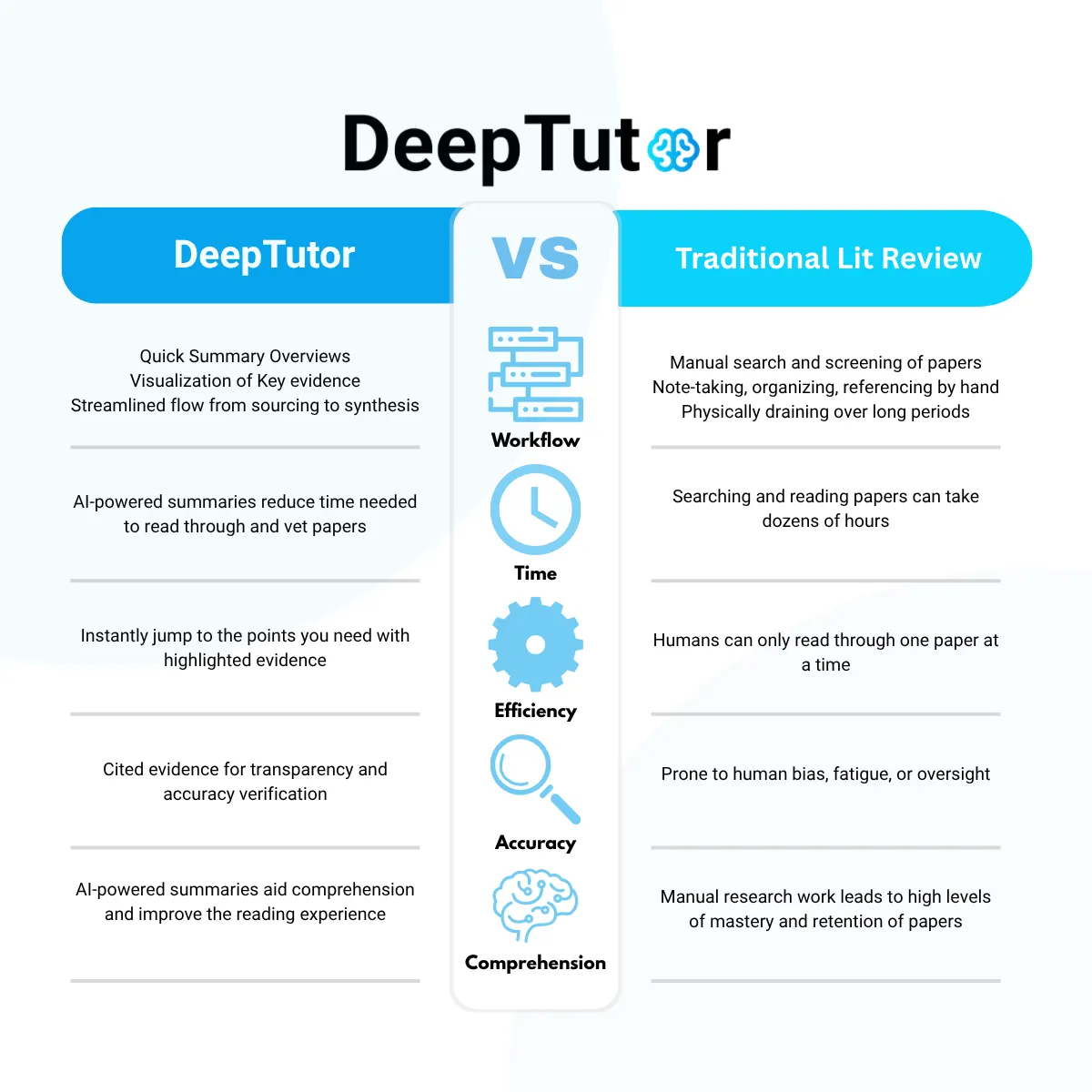
Traditional literature review methods involve searching, screening, reading, organizing, and synthesizing data, which is time-consuming and repetitive manual work. This page will aim to compare traditional literature review methods with AI-powered research using DeepTutor by highlighting the differences in workflow, efficiency, and insight generation.
Workflow
The purpose of literature reviews is to create a coherent overview of a certain topic to understand the current state of knowledge and identify possible research gaps. A literature review is the result of a thorough search, analysis, and synthesis over a long period of time.
The search process is the beginning of the workflow. This would involve sifting through databases and reading abstracts to find relevant papers. After finding a sufficient number of sources, the next stage is to read and comprehend each paper to take detailed notes for future reference. The completion of these two stages allows the synthesis stage to begin, so you can finally start connecting ideas across papers to start creating an overview.
The workflow for a literature review requires manually organizing papers, re-reading them, and keeping up with your notes, which are all time-consuming individually. With the number of papers you might be managing, there is an added risk of missing insights and forming biases.
Without external assistance, the amount of work a literature review calls for is physically and mentally draining. However, this workflow can be streamlined by introducing AI tools to take care of the time-consuming tasks.
With the introduction of AI tools, researchers gain access to automated summaries, key evidence extraction, and synthesis aids. Regardless of the topic, AI can assist the workflow of the literature review process by taking care of the tasks that would have taken up hours of researchers’ time.
DeepTutor document summaries aid both the search and reading process when creating a literature review. Having an automated summary means that researchers can spend less time verifying if a paper is relevant to the review. Likewise, with a summary, researchers gain a better understanding of the paper, which decreases the amount of time it takes for comprehension.
Evidence extraction and visualization is an aid for researchers so they can spend less time re-reading documents and have all the information they need organized and ready for synthesis. DeepTutor can eliminate the need to navigate between multiple documents, decreasing the chance of mistakes being made because of the sheer workload, and increasing the amount of time researchers can spend on synthesis.
The levels of complexity and difficulty for a paper can differ from the paper itself and the researcher’s own ability to understand the text. However, with the ability of DeepTutor to break down complicated text, researchers can quickly grasp the essence of a text for synthesis regardless of the topic.
At all stages, DeepTutor has the power to enhance the literature review workflow to save time for researchers. Though AI has its limitations, its ability to quickly perform repetitive and time-consuming tasks means researchers can focus their energy on analysis, not paperwork.
Time & Efficiency
Literature reviews are important for the progression of science. They require thorough work, and the number of papers that are managed creates an enormous workload.
For a traditional literature review, there are two main preliminary processes before you can even start synthesizing. This would be the search process and the reading process.
Literature reviews require a large number of documents to create a coherent overview. This means researchers must manually review databases to find documents that may pertain to their study, and this task consumes a significant amount of time, regardless of the researcher’s reading speed.
Humans also have the limited capability of reading one paper at a time. This inefficiency is exacerbated by the combination of a large number of papers, their respective difficulties, and the researcher’s reading speeds. This is still applicable during the search stage, and it becomes even more prevalent during the reading stage.
When juggling 20–50 different papers, each with an average read time of 30 minutes, researchers will spend about 20 hours just to get the first read. When factoring in additional reads for comprehension, the time that the reading process takes grows exponentially.
The traditional approach to literature reviews consumes a large amount of time. Though spending a large amount of time on these tasks is not necessarily a bad thing, the introduction of AI to these workspaces are perspective perspective-changing when looking at the levels of efficiency at which they produce work.
The ability that AI has to create summaries will drastically reduce the amount of time needed for a literature review. DeepTutor-powered summaries will make vetting papers and understanding them easier, easing the workload that researchers would traditionally have.
Using AI, researchers no longer have to invest their time searching for papers that may or may not be relevant to their study. DeepTutor-powered summaries can give researchers a quick understanding of the paper, giving them the option of assessing relevance in minutes rather than hours.
Summaries are not just useful to decide relevance, as having a good understanding of the paper before reading can increase comprehension rate. This makes reading more efficient because researchers would be able to focus their bandwidth on the key parts of the paper, instead of trying to decipher the entire work.
Though DeepTutor can be useful in saving time, it does not mean that it can replace the work of researchers. Human supervision is necessary for the effective use of AI, ensuring that the speed at which AI works is accurate and relevant.
Accuracy & Comprehension
Literature reviews require the highest level of interpretation to give an accurate overview of the state of research. This is a scenario where the human capability of only being able to focus on one thing at a time becomes an advantage.
In traditional literature reviews, researchers have to spend a vast amount of time going through each paper. However, that time spent will result in a precise understanding of the paper, a level of accuracy that can not easily be replicated, especially since comprehension is different for every individual.
The manual act of reading through papers will not only result in an accurate interpretation, but it will also give researchers an easier time in actually learning and remembering the content. The time it takes for researchers to read and re-read papers will result in a mastery of the work earned through repetition.
Though the human capability for accurate interpretation is high, there is plenty of room for error, since humans are not perfect beings. Whether it is through exhaustion or through bias, there is a possibility of oversight when humans read through documents.
Though constrained to one task at a time, the human ability to precisely interpret work is strong, and the slow speeds at which this interpretation occurs give humans the time to master documents for full comprehension.
The capabilities of AI can greatly enhance the research workflow. However, when it comes to accuracy and comprehension, there is a necessity for the manual work of researchers.
When it comes to accuracy with AI, there is always a sense of skepticism due to the existence of hallucinated responses. This can pose a major issue for literature reviews because the validity of information is essential, but since DeepTutor always cites the evidence it sourced its answer from, researchers can always verify accuracy without going through an entire document again.
Though AI can provide summaries that aid comprehension, these are only a starting point. True understanding still requires researchers to engage deeply with the material. Relying too heavily on AI risks creating a habit of superficial reading, where comprehension and mastery of the text are sacrificed for convenience.
Accuracy and comprehension are challenges that AI cannot solve alone — they require careful use and active human oversight. While AI can support researchers, its limitations must be balanced by critical human judgment. Ensuring accuracy and retaining understanding ultimately depend on consistent human involvement, no matter what tools are used.
Conclusion
The introduction of AI has given researchers a new option to approach literature reviews, with tools that automate the once tedious steps and streamline the entire research process. While there is a faster approach using tools like DeepTutor, traditional literature reviews foster a deep understanding of the material because of the invested effort and time from researchers. Each approach has its own benefits when it comes to literature reviews, and should be used accordingly to your own personal needs.
Continue exploring
Zotero AI assistant overview
See how DeepTutor fits into a Zotero-based workflow for paper reading and cited answers.
DeepTutor vs ChatGPT for research
Compare general-purpose AI with a source-grounded workflow for academic PDFs.
Browse all DeepTutor guides
Read more tutorials on literature review, AI paper analysis, and Zotero workflows.